Cart
0
You may also like


The wedding veil meaning runs far deeper than lace and tulle, weaving together Scripture, centuries of church tradition, and a quiet personal invitation to step into something sacred. For generations of Christian brides, the veil has been both a visible sign of reverence and a soft framing of the face during the most significant yes of their lives. Understanding where the tradition comes from, how the church has shaped it, and how modern brides are choosing to carry it helps the veil become what it was always meant to be: a meaningful object rather than a decorative afterthought.
This guide traces the wedding veil meaning from the Old Testament through early Christianity and into the denominational traditions you will recognize today. It also looks briefly at how other cultures use veiling, so the Christian story can be read in its wider context. If you are choosing a veil for a faith-centered ceremony, the final sections include practical guidance on styles, materials, and how to choose a veil that holds meaning as well as beauty.

Bride: Mackenzie Murph, Arkansas, USA. Veil: Kaitie from the Organza wedding veils collection. Photo: Laura Powers.
The earliest traces of bridal veiling in the biblical canon appear in the story of Rebekah in Genesis 24. As she approaches Isaac for the first time, she takes a veil and covers herself. Many Christian readers treat this moment as the quiet beginning of bridal veiling in Scripture, a gesture of modesty, reverence, and the beginning of covenant.
Old Testament veiling shows up in other corners of the text as well. Moses veils his face after speaking with God in Exodus 34, so that the lingering radiance of that encounter does not overwhelm the people. The Temple in Jerusalem was divided by a heavy veil that separated the Holy of Holies from the rest of the sanctuary. In the New Testament, that Temple veil is torn in the moment of the crucifixion, which Christian theology reads as a sign that the separation between God and humanity has been opened.
Paul's letters to the church in Corinth, particularly 1 Corinthians 11, address head covering during prayer and worship. Scholars continue to debate the cultural and theological weight of that passage, but for many centuries the early church read it as a call to reverence in sacred spaces. As Christianity spread through the Mediterranean and into Europe, those worship customs gradually shaped wedding liturgy, and the bridal veil became a recognizable part of the ceremony rather than an ornament imported from civic Roman weddings.
At its simplest, a veil covers. That single act has been read in at least four different ways within Christian tradition, and most brides today carry a little of each reading with them down the aisle.
Modesty. In the early church, head covering was tied to humility before God. A bride approached the altar with her head and face softly shielded, a visual reminder that the moment was not about performance but about presence. Modesty in this sense is not a critique of the body. It is a posture of attention.
Mystery. The veil introduces a small withholding. For a short stretch of the ceremony the bride's face is softened by fabric, her features suggested rather than displayed. That restraint gives weight to the moment when the veil is lifted and the face appears.
Reverence. Because the veil carries echoes of the Temple curtain and of Moses on Sinai, Christian tradition has often treated it as sacred cloth. To wear one is to borrow, gently, from a much older vocabulary of holy ground.
Transition. A bride in a veil is in motion between one life and the next. The covering marks the threshold, and the uncovering marks the crossing. This is why brides often describe the walk down the aisle as one of the most emotional moments of the day, even before the vows begin.

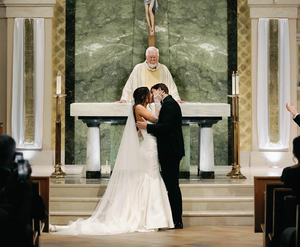
If the covering of the veil carries one layer of meaning, the lifting carries another. In a traditional Christian ceremony the bride enters with her face softly covered by a blusher, often lifted by her father as he reaches the altar. The groom may then lift the longer layer at the moment of the kiss, or the bride may lift it herself.
Each of these choreographies carries a different reading. When a father lifts the blusher, he echoes the older image of giving his daughter into a new covenant. When the couple lift the veil together, or when the bride lifts it alone, the gesture reads as shared agency and a mutual beginning. There is no single correct version. The lifted veil, however it happens, is the ceremony's quiet moment of revelation.
Many couples describe the instant the veil rises as the first time the noise of the day falls away. They see one another clearly, often through tears, and the public ceremony becomes briefly, almost privately, theirs. That is the heart of the wedding veil meaning in Christian practice: a sacred covering that exists precisely in order to be lifted in trust.

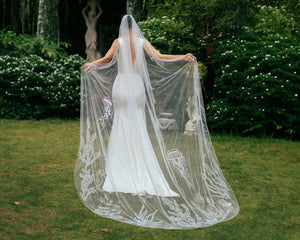
Bride: Paulina Leal, Zapopan, Mexico. Veil: Lilly from the Floral veils collection. Photo: danielagtzh.com.
Contemporary Christian brides are choosing veils differently than their grandmothers did. Where earlier generations wore a veil because it was expected, today's brides more often choose one because it anchors a feeling they want the day to carry. The tradition still gestures toward reverence and covenant, but the emphasis has shifted from obligation to meaningful choice.
That shift is visible in the fabric itself. Many brides now commission traditional long veils in cathedral length because they want the dramatic sweep of an older liturgical aesthetic. Others choose shorter chapel or fingertip veils that feel intimate and unfussy. A growing number commission custom embroidery that incorporates personal meaning: a favorite verse stitched at the edge, a monogram, or a small motif drawn from family heritage.
The evolution is not a dilution. If anything, it deepens the wedding veil meaning for the bride who chooses it intentionally. When a veil is picked because it carries something true about the bride's faith or family rather than because the checklist required it, the fabric becomes a kind of vow in its own right.
Christianity is not a single tradition but a family of them, and different branches relate to the wedding veil in their own ways.
Catholic. Catholic weddings retain the strongest liturgical presence for veiling. In some Spanish and Latin American traditions, a lazo or velacion cloth is draped across the shoulders of both bride and groom during the ceremony, extending the symbolism of covering to the couple as a unit. Mantilla veils, often in lace, have a long history in Catholic bridal practice and remain a favored choice for brides who want an explicitly devotional style. For the underlying chronology, see our long history of the bridal veil.
Orthodox. In Eastern Orthodox and Oriental Orthodox weddings, crowning rather than veiling takes center stage, but the bride is often still veiled as she enters. The crowning ceremony that follows, in which crowns are placed on both the bride and groom, reflects a theology of the couple as co-heirs of the marriage covenant.
Protestant. Protestant weddings span a wide spectrum. Many brides in mainline Protestant traditions wear a veil for continuity with Christian heritage, while evangelical and non-denominational weddings often treat the veil as an aesthetic choice rather than a sacramental one. Either approach is normal, and neither is considered more or less faithful.
Anglican. Anglican and Episcopal ceremonies tend to preserve classic English liturgical elements, including traditional veiling. The blusher and cathedral silhouette are both common, and many couples follow the older choreography of the father lifting the blusher at the altar.

Understanding the wedding veil meaning in Christianity becomes easier when you see how other traditions approach the same gesture. A brief look outward is not a detour but a frame.
In Jewish weddings the bedeken is the moment just before the ceremony when the groom places the veil over the bride's face himself. The practice traces back to the story of Jacob, Rachel, and Leah in Genesis, and it is read today as the groom affirming that he sees and chooses this particular person. In Hindu weddings the ghoonghat, a loose covering drawn over the head and sometimes across the face, carries meanings of modesty, respect for elders, and the crossing into a new family. Islamic wedding practice includes a range of head coverings, with the specific form varying widely by culture and region.
These traditions are not interchangeable with the Christian veil, and they are not meant to be borrowed casually. But knowing they exist reminds us that veiling is one of humanity's oldest gestures around marriage, and that the Christian practice participates in a much wider human vocabulary of covering, crossing, and reverence.
If the symbolism of the veil resonates with you, a few gentle choices can help the fabric say what you want it to say. Think about veil styles and length first, because silhouette often shapes feeling more than any surface detail. A cathedral length veil lends itself to formal, sacred-space ceremonies. A chapel length sits softly for smaller services. A fingertip length moves easily through outdoor or less liturgical settings.
Consider the fabric as well. Fine tulle reads as light and luminous, organza holds more structure and catches light in soft ribbons, and lace carries the quiet weight of heritage. A blusher adds the traditional moment of unveiling. Personal details like a hand-embroidered edge, a stitched verse, or a family lace insert turn the veil into a quiet heirloom.

Bride: Anna Dietrich, MI, USA. Veil: Cassandra from the Beaded wedding veils collection. Photo: Lydia Charles.
Whatever shape the tradition takes in your ceremony, the wedding veil meaning at its core is a small act of reverence. You are marking a moment as set apart. You are saying, with fabric rather than words, that this day matters. The bride who walks with her face softly covered and then lifts the veil into her partner's gaze is participating in a gesture that is older than most of our churches and still tender enough to feel new.
Choose the veil that honors where you come from, what you believe, and the person you are becoming. The tradition has always had room for that.
A wedding veil symbolizes modesty, mystery, reverence, and the threshold between one season of life and the next. In Christian tradition it carries an added layer: the bride approaches her vows with a covered face as a gesture of humility before God, and the lifting of the veil marks a moment of revelation shared with her partner. Modern brides often choose the veil as an emotional anchor, a soft sign that this day is set apart from every other.
Christian brides wear a veil because the practice grew out of early church customs around head covering, which were tied to prayer, worship, and marriage. Over centuries the veil became a visual language of consecration, meaning something set apart for a sacred purpose. Today a Christian bride may wear one to honor her faith, echo generations of women before her, or simply to carry a quiet sense of the sacred into her ceremony.
The Bible does not command brides to wear a veil in the modern sense, but it does reference veiling in several places. Rebekah covers herself with a veil when she first meets Isaac in Genesis 24. Paul discusses head coverings during prayer and worship in 1 Corinthians 11. Moses veils his face after encountering God in Exodus 34. Taken together, these passages treat veiling as a posture of reverence rather than a strict rule, and most Christian traditions today view the bridal veil as a symbolic continuation of that posture.
Tradition varies. In many Christian ceremonies the father of the bride lifts a blusher veil at the altar as he presents his daughter, and the groom lifts the veil again at the moment of the kiss. In other ceremonies the bride lifts her own veil as an act of agency and choice. There is no single correct answer, and couples are free to shape the moment around the story they want to tell.
A blusher is the shorter layer of a veil that falls over the bride's face during the processional. Its meaning is closely tied to the themes of mystery and revelation. When the blusher is lifted, the bride and groom see one another clearly for the first time in the ceremony, which many couples describe as a quiet, intimate pause inside a very public moment.
No. A veil is a tradition, not a requirement. Most Christian denominations leave the choice entirely to the bride. Some brides feel strongly drawn to the symbolism, others prefer to walk the aisle without one, and both choices are fully in keeping with a faith-centered ceremony.
Cathedral length veils, which typically fall between 108 and 120 inches, are the most traditional choice for a formal church wedding. They extend beyond the train of the gown and carry a sense of ceremony down a long aisle. Chapel length veils are a softer alternative for shorter aisles or more intimate services.

Hoa is the founder and owner of Tara Bridal, bringing over seven years of experience in designing bespoke wedding veils for more than 3,000 brides worldwide. Passionate about helping brides shine with a unique style, she brings fresh ideas into each accessory, breaking traditional molds. Hoa understands the fatigue and time-consuming search that brides face when looking for wedding veils online, which is why she strives to create a seamless and enjoyable shopping experience. She creates stunning veils that beautifully reflect each bride's individuality by blending global fashion trends with exquisite hand embroidery from skilled Vietnamese artisans.