Cart
0
You may also like


The wedding veil is one of the few accessories that carries real weight on your wedding day. It frames your face, anchors the silhouette of your gown, and shapes the photographs you will live with for the rest of your life. Choosing among the many types of wedding veils is less about following a trend and more about finding the length, fabric, and detail that complete the picture you already see in your head.
At Tara Bridal, every veil is handmade in Hanoi by artisans who work petal by petal, stitch by stitch, in fine organza, tulle, and lace. This guide walks you through every common type of wedding veil by length and by style, with notes on how each one moves, photographs, and pairs with the rest of your bridal look. Use it as a starting point for your own choice, then let your dress, venue, and instinct lead the way.
Before getting into types, it helps to understand what the veil actually does. A veil is a length of soft fabric, usually tulle or fine net, attached to a comb or barrette and worn over the hair. It is symbolic, sensory, and structural all at once. Across cultures, the veil has carried meanings of modesty, transition, reverence, and protection. For a deeper look at the symbolism, see our piece on the meaning of the wedding veil. For a closer read on the fabrics themselves, our wedding veil materials guide covers silk tulle, organza, lace, and how each one drapes.
Length is the first decision, because it sets the visual scale of the entire look. A short blusher reads playful and modern. A cathedral veil reads cinematic and traditional. Each length has its own behaviour in motion and in photographs.
The royal cathedral is the longest of all wedding veil lengths, trailing well past the chapel hem of any gown. It is a statement choice for grand venues, long aisles, and brides who want a true heirloom moment. Royal cathedral veils photograph with extraordinary depth and movement, and they pair best with structured ball gowns or fitted mermaid silhouettes that can carry the visual weight.
A cathedral wedding veil typically extends 108 to 120 inches from the comb, falling roughly six to eight feet behind the bride. It is the classical choice for a formal church wedding and the length most associated with traditional bridal photography. Cathedral veils made in fine tulle move beautifully, while organza or lace cathedrals add structure and a more sculptural drape.
The chapel veil falls just past a standard wedding gown train, around 90 inches in length. It feels less imposing than a cathedral but still carries clear formal weight. If you want length and movement without the logistics of a six-foot trail, a chapel-length veil is a balanced middle ground. We compare these two in detail in our guide to chapel veil vs cathedral veil.
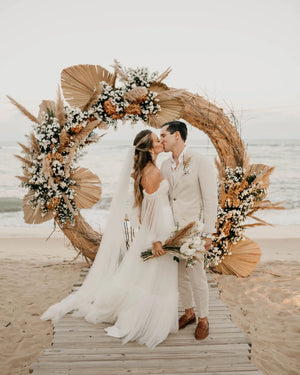
The waltz veil ends somewhere between the knee and the ankle. It is romantic and easy to wear, with enough length to soften the silhouette without trailing on the floor. Waltz veils are a strong fit for outdoor and garden weddings, where a longer veil can drag through grass or sand, and live alongside the rest of our beach wedding veils.
The fingertip veil reaches, as the name suggests, the tips of your fingers when your arms hang at your sides. It is the most versatile length in modern bridal, working with almost every gown silhouette and almost every venue. Fingertip is also the most photogenic length for second-look reception veils and shorter ceremonies.
The elbow-length veil sits at, or just below, the bend of the arm. It reads modern and clean, and pairs especially well with fit-and-flare gowns that have an open back or a strong waist detail. Elbow-length floral veils, with embroidery clustered at the hem, photograph particularly well in close-up portraits.
The shoulder veil grazes the top of the shoulders. It is short, light, and very modern. Shoulder veils suit minimalist gowns, civil ceremonies, and brides who want a soft hint of veil rather than a full sweep of fabric.
The blusher is the front layer of fabric that covers the face during the processional. It can be worn alone as a short, vintage-inspired veil, or attached to a longer two-tier veil. The birdcage is a stiffer net that frames just the face, evoking the styling of 1940s and 1950s brides. Both are excellent choices for elopements, registry weddings, and tea-length gowns.
Once length is decided, style is what gives the veil its character. Style covers the fabric, the trim, the embroidery, and any embellishment along the edge or across the body of the veil.
The plain tulle veil is the foundation of bridal. Soft, weightless, and almost invisible at the edge, it lets the gown speak. Tulle veils work in any length and on any silhouette, and they can be left raw-edged for a clean modern finish, or trimmed in a fine ribbon or pencil edge for a more polished look.
A lace wedding veil trims the edge or scatters appliqué across the body of the veil with handmade lace, French lace, or Chantilly lace. Lace adds detail and softness, and reads romantic without tipping into ornate. A lace-trimmed cathedral veil is a particularly classical choice; a lace-bodied chapel veil reads more contemporary.
Organza is a finer, slightly stiffer fabric than tulle. An organza veil holds its shape, drapes with a clean line rather than a soft cloud, and adds a quiet, sculptural quality to the silhouette. Organza is the fabric we reach for when a bride wants the veil itself to feel like a piece of structured artistry.
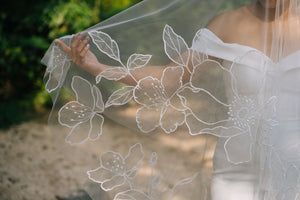
The floral embroidered veil is the Tara Bridal signature. Petals, vines, and full bouquets are embroidered by hand directly onto tulle or organza, with the placement and density designed around the bride. Each floral wedding veil takes hundreds of hours of needlework, and no two are exactly alike. Floral veils work especially well with simple gowns that give the embroidery room to breathe.
The 3D floral veil takes embroidery a step further. Individual petals are constructed in fabric, hand-stitched, and applied to the body of the veil so they catch the light and lift slightly off the surface. The effect in motion and in photographs is closer to a garden than a flat embroidery. 3D veils reward close-up portraits.
A beaded veil carries seed beads, glass pearls, or crystal accents stitched along the edge, scattered across the body, or worked into a beaded floral motif. Beadwork adds quiet shimmer in low ceremony light and shows up beautifully in candid evening photographs. Heavier beaded veils sit best at chapel or cathedral length.
Pearl-trim veils edge the veil with a delicate run of glass or freshwater pearls. Pearl trim is one of the most timeless detailing choices in bridal and pairs especially well with gowns that already feature pearl bodice work or pearl earrings.
Colour is no longer reserved for second-look gowns. Colorful embroidered veils take the same hand technique as our floral signature and work it in soft blush, warm gold, sage, or full polychrome. Colorful veils suit brides who want their veil to feel personal rather than predictable, and they photograph as a quiet surprise during the ceremony reveal.
Length and style are two independent dials, and the way you set them is the easiest way to control the formality of your overall look. Cathedral length plus plain tulle reads grand and traditional. Cathedral length plus dense floral embroidery reads grand and editorial. Fingertip plus lace edge reads soft and classic. Fingertip plus 3D floral reads contemporary and a little daring. Shoulder plus colourful embroidery is the modern bride at a city wedding.
If you are unsure which dial to turn, hold the dress and the venue in your mind first. A traditional church wedding tends to call for length. An outdoor or beach ceremony tends to call for less. From there, let the gown decide style: a heavily detailed dress wants a quieter veil, and a clean, minimalist gown wants a veil with more to say.
Beyond length and style, four practical factors should shape your final choice.
Your dress silhouette. Ball gowns and A-line silhouettes hold longer veils gracefully. Sheath and column gowns tend to look balanced with chapel or fingertip lengths. Open-back and low-back gowns are best left visible, which usually means a shorter veil or a single-tier rather than a double.
Your venue. Long aisles, marble floors, and grand staircases reward long veils. Garden, beach, and barn settings reward shorter, lighter veils that move with the wind without dragging.
Your hair. An updo gives a veil a stable anchor, and the comb sits cleanly tucked beneath the style. A half-up or down style can still hold a veil beautifully, but the comb position needs more care, and a smaller, lighter veil is often the kinder choice.
Your photography style. Editorial photographers love long, moving veils for portraits in motion. Intimate, documentary photography is often better served by a fingertip or shoulder veil that does not compete with the bride or the moment.
Wedding veils are usually classified two ways. By length, the main types are royal cathedral, cathedral, chapel, waltz, fingertip, elbow, shoulder, and blusher or birdcage. By style or material, the main types are plain tulle, lace, organza, floral embroidered, 3D floral, beaded, pearl-trim, and colorful embroidered. Most veils combine one length with one style, and the combination defines the overall look.
Fingertip is the most-worn length in modern weddings because it pairs with almost every gown silhouette and venue. Cathedral remains the most-photographed length, especially for traditional church weddings, because of how it moves and how it photographs in motion. Chapel sits between the two and is a strong choice when a bride wants length without a long trail.
Start with the silhouette of your gown. Heavily detailed bodices and lace gowns suit a quieter veil, often plain tulle or a soft lace edge. Minimal, clean gowns can carry a more decorative veil, including floral embroidery or 3D petal work. Match the formality of the veil to the formality of the dress, and let length follow venue.
The simplest difference is length. A chapel veil falls around 90 inches from the comb. A cathedral veil falls between 108 and 120 inches. A chapel veil ends just past the train of a typical gown; a cathedral veil extends six to eight feet beyond. Cathedral reads more formal and cinematic, chapel reads slightly less imposing while still carrying clear traditional weight. We cover both in detail in our chapel veil vs cathedral veil guide.
Yes, with care. The rule of thumb is to vary the scale. If your gown features small, dense, all-over lace, choose a veil with larger, more sparsely placed motifs so the two do not blur together. If your gown features bold lace appliqué, a quieter veil with a fine lace edge usually balances the look. Avoid matching the exact same lace pattern in both pieces; the contrast of scale is what makes both elements read clearly in photographs.
The answer depends on your gown silhouette and your venue. A long, traditional church aisle and a structured gown can carry a cathedral or royal cathedral veil. A garden, beach, or destination wedding is usually better served by a fingertip, waltz, or shoulder veil. If you are unsure, fingertip is the safest universal length and works with almost every silhouette.
Outdoor and beach weddings favour lighter, shorter veils because of wind, sand, and uneven ground. Fingertip, waltz, and shoulder lengths in fine tulle or organza all work well. A floral embroidered fingertip veil is a particularly photogenic option for garden weddings, and a plain tulle waltz veil is a quiet classic for ceremonies on sand.
The right veil is the one that feels like yours. Length and style matter, but the moment of putting the veil on for the first time, in front of a mirror, is the one that tends to settle the choice. At Tara Bridal, every veil is handmade to order, and most styles can be customised in length, embroidery placement, and colour. If none of the styles in this guide feel exactly right, our bespoke service is built for that conversation.

Hoa is the founder and owner of Tara Bridal, bringing over seven years of experience in designing bespoke wedding veils for more than 3,000 brides worldwide. Passionate about helping brides shine with a unique style, she brings fresh ideas into each accessory, breaking traditional molds. Hoa understands the fatigue and time-consuming search that brides face when looking for wedding veils online, which is why she strives to create a seamless and enjoyable shopping experience. She creates stunning veils that beautifully reflect each bride's individuality by blending global fashion trends with exquisite hand embroidery from skilled Vietnamese artisans.